
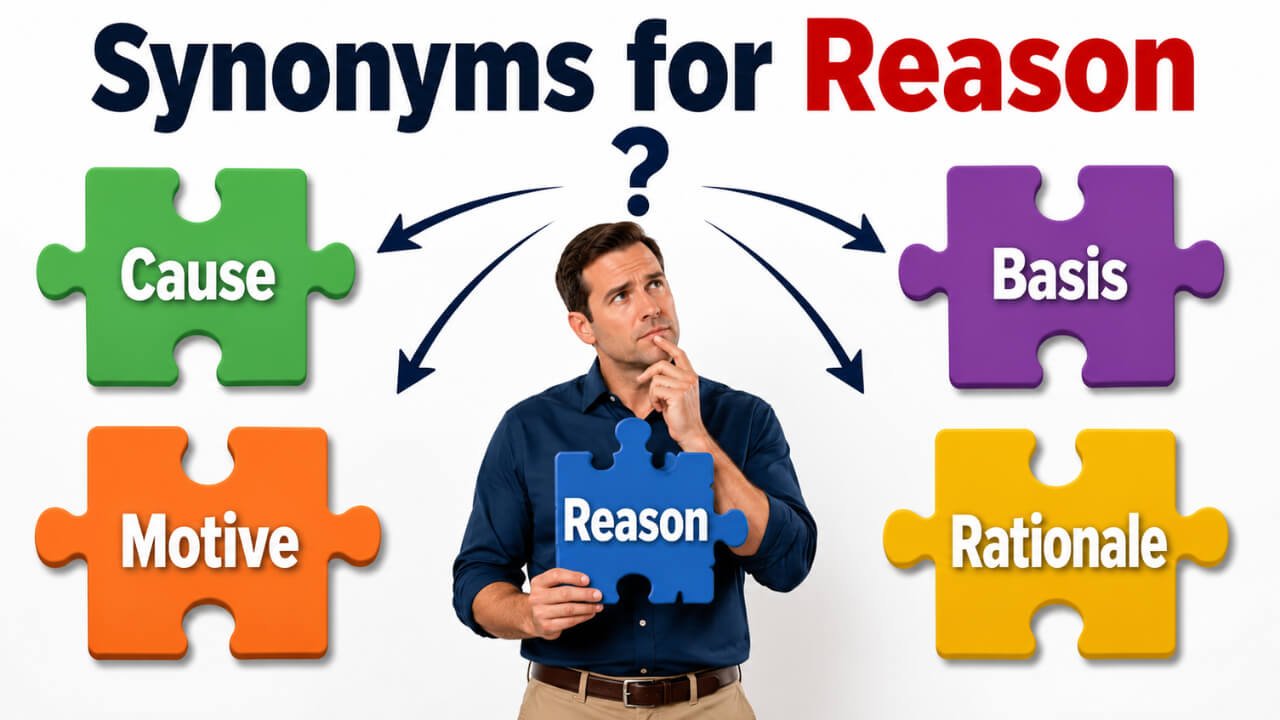
Quick Answer: Synonyms for reason include cause, explanation, motive, purpose, basis, justification, logic, ground, rationale, and argument. Use cause when talking about why something happened, explanation when giving details, motive when describing intention, purpose when showing aim, basis when showing support, justification when defending an action, and logic when referring to clear thinking or sound judgment.
Pronunciation and Word Details
Word: Reason
Pronunciation: ˈriːzən
Part of Speech: Noun and verb
Meaning: Reason means the cause, explanation, purpose, or logical thought behind something.
US Pronunciation:
UK Pronunciation:
What Does “Reason” Mean?
Reason means the cause, explanation, or purpose behind an action, event, belief, or decision. As a noun, it can refer to why something happened, why someone did something, or the logical basis for an idea. As a verb, reason means to think clearly, judge carefully, or form a conclusion through logic.
The word reason works in many sentence contexts. In daily speech, it often means why something happened. In essays, reports, and formal writing, it can mean explanation, evidence, logic, or justification. In emotional contexts, reason may refer to a personal motive or inner cause.
Meaning, Tone, and Context of “Reason”
Reason is a neutral and flexible word. It is common in formal writing, casual speech, academic discussion, business communication, and everyday conversation. The tone depends on the context.
In simple conversation, reason often means cause or explanation. In formal writing, it may mean basis, rationale, or justification. In academic writing, it can suggest logic, evidence, or argument. In emotional writing, it may point to motive, purpose, or personal intention.
Reason is useful because it can explain both facts and thoughts. However, more specific synonyms can make writing clearer when the exact meaning matters.
When and How to Use “Reason”
For Cause: Use reason when explaining why something happened.
Example: The reason for the delay was heavy traffic.
For Explanation: Use reason when giving details behind a statement, action, or result.
Example: She gave a clear reason for changing the schedule.
For Purpose: Use reason when describing the aim behind an action.
Example: His main reason for studying abroad was to gain wider experience.
For Logic: Use reason when talking about clear thinking or judgment.
Example: A good decision should be based on reason, not pressure.
For Justification: Use reason when defending or supporting a choice.
Example: There is no strong reason to cancel the meeting.
For Motive: Use reason when explaining a person’s personal intention.
Example: Her reason for leaving was completely understandable.
Best Synonyms for Reason
Cause: The thing that makes something happen.
Example: The main cause of the problem was poor planning.
Explanation: A statement that makes something clear.
Example: He gave a simple explanation for the mistake.
Motive: A personal reason for doing something.
Example: The detective wanted to know the motive behind the act.
Purpose: The aim or goal behind an action.
Example: The purpose of the rule is to protect everyone.
Basis: The main support or foundation for an idea.
Example: The decision has a strong basis in evidence.
Justification: A reason used to defend or support something.
Example: There was little justification for such a harsh response.
Logic: Clear and reasonable thinking.
Example: The logic behind her answer was easy to follow.
Rationale: A formal explanation for a decision or belief.
Example: The report explains the rationale for the new policy.
Ground: A reason or basis for belief, action, or complaint.
Example: They had no legal ground for the claim.
Argument: A reason or set of reasons used to support an opinion.
Example: His argument was strong because it used clear facts.
50 Synonyms for Reason with Short Meanings
- Cause: Something that makes an event happen.
- Explanation: A clear statement that tells why.
- Motive: A personal reason for an action.
- Purpose: The aim behind doing something.
- Basis: The foundation for a belief or decision.
- Justification: A reason that supports or defends something.
- Logic: Clear thinking based on sense.
- Rationale: A formal reason behind a choice.
- Ground: A basis for action, belief, or complaint.
- Argument: A reason used to support an idea.
- Point: The main idea or purpose.
- Intent: The purpose someone has in mind.
- Intention: What someone plans or means to do.
- Aim: The goal someone wants to reach.
- Objective: A planned goal or purpose.
- Goal: The desired result of an action.
- Explanation: A reason that makes something understandable.
- Account: A description that explains what happened.
- Excuse: A reason given to avoid blame.
- Pretext: A false reason used to hide the real one.
- Evidence: Information that supports a claim.
- Proof: Facts that show something is true.
- Support: Information that strengthens an idea.
- Foundation: The base on which an idea rests.
- Principle: A basic belief or rule behind action.
- Rationality: The quality of being based on reason.
- Sense: Practical and reasonable judgment.
- Judgment: The ability to make careful decisions.
- Thinking: The process of using the mind.
- Analysis: Careful study used to understand something.
- Inference: A conclusion based on facts.
- Conclusion: An idea reached after thinking.
- Grounds: Reasons used to support a claim.
- Case: A set of reasons supporting a view.
- Defense: Reasons used to protect or justify something.
- Clarification: Details that make something clearer.
- Meaning: The idea or sense behind something.
- Significance: The importance or meaning of something.
- Source: The origin or cause of something.
- Origin: The starting point of something.
- Root: The basic cause of a problem or situation.
- Factor: Something that helps produce a result.
- Condition: A situation that affects an outcome.
- Impulse: A sudden reason or urge to act.
- Drive: Strong inner motivation.
- Incentive: Something that encourages action.
- Motivation: The reason that makes someone act.
- Need: A reason based on necessity.
- Necessity: Something required or unavoidable.
- Consideration: A factor thought about before deciding.
Read Also:
Synonyms for Ugly

Synonyms for Reason by Context
When Reason Means Cause
Reason can mean the cause of an event, problem, action, or result. In this context, stronger alternatives include cause, source, root, factor, and origin.
Cause: The main thing that makes something happen.
Example: The cause of the error was a missing file.
Source: The starting point of a problem or result.
Example: Stress was the source of his poor performance.
Root: The deepest cause of something.
Example: The root of the issue was poor communication.
Factor: One part of a larger cause.
Example: Cost was an important factor in the decision.
When Reason Means Explanation
Reason can also mean an explanation that helps someone understand why something is true or why something happened. Good synonyms include explanation, account, clarification, and rationale.
Explanation: A clear statement that tells why something happened.
Example: Her explanation made the problem easier to understand.
Account: A description of events or causes.
Example: He gave a detailed account of the incident.
Clarification: Extra details that remove confusion.
Example: The manager gave clarification about the new rule.
Rationale: A formal explanation behind a decision.
Example: The document explains the rationale for the change.
When Reason Means Purpose
Reason often means the aim or purpose behind an action. Useful synonyms include purpose, aim, objective, goal, intent, and intention.
Purpose: The reason something is done.
Example: The purpose of the training is to improve safety.
Aim: The result someone wants.
Example: Her aim was to finish the work before Friday.
Objective: A clear planned goal.
Example: The objective of the project is to reduce waste.
Intent: What someone means or plans to do.
Example: His intent was to help, not criticize.
When Reason Means Logic
Reason can mean logical thinking, good judgment, or mental clarity. In this context, use logic, sense, rationality, judgment, or analysis.
Logic: Clear thinking based on facts.
Example: The logic behind the decision was strong.
Sense: Practical and reasonable thinking.
Example: It makes sense to check the details first.
Rationality: The quality of being reasonable.
Example: Her argument showed calm rationality.
Analysis: Careful thinking used to understand something.
Example: The analysis gave strong support to the final answer.
When Reason Means Justification
Reason can mean a defense or support for an action, opinion, or decision. Useful options include justification, ground, basis, support, defense, and argument.
Justification: A reason used to defend something.
Example: There was no justification for the rude reply.
Ground: A reason that supports action or belief.
Example: They had enough ground to raise a concern.
Basis: The foundation of a decision or idea.
Example: The basis of the claim was reliable evidence.
Argument: A reason used to support a position.
Example: Her argument was clear and well organized.
Another Word for Reason
Another word for reason is cause when you mean why something happened. However, the best alternative depends on context. Use explanation when you want to clarify something, purpose when you mean aim, motive when you mean personal intention, and logic when you mean clear thinking.
Original: The reason for the delay was bad weather.
Better Option: The cause of the delay was bad weather.
Original: He explained the reason for his decision.
Better Option: He explained the rationale for his decision.
Original: Her reason for joining was simple.
Better Option: Her purpose for joining was simple.
Original: There is no reason to believe the claim.
Better Option: There is no basis to believe the claim.
When Not to Use “Reason”
Do not use reason when a more specific word would make the sentence clearer. Reason can sound vague if the writer does not show whether it means cause, purpose, motive, explanation, or logic.
Avoid repeating reason too often in one paragraph. In formal writing, use rationale, basis, justification, or explanation when you need precision. In emotional or personal contexts, motive or purpose may sound clearer.
Weak: The reason for the reason she left was unclear.
Better: The motive behind her departure was unclear.
Weak: The reason of the problem was poor planning.
Better: The cause of the problem was poor planning.
Weak: His reason was not very logical.
Better: His explanation was not very logical.
Weak: We need a reason for this decision.
Better: We need a clear rationale for this decision.
Words Commonly Confused With Reason
Reason vs Cause: Reason is broader and can mean cause, purpose, or explanation. Cause mainly means the thing that makes something happen.
Reason vs Explanation: Reason tells why something happened or why someone acted. Explanation gives details that make the reason clear.
Reason vs Motive: Reason can be general, but motive usually refers to a personal or hidden intention behind an action.
Reason vs Purpose: Reason explains why something is done. Purpose focuses more on the goal or aim.
Reason vs Logic: Reason can mean why something happened, but logic means clear thinking or a sensible process of thought.
Reason vs Justification: Reason may simply explain something, while justification defends it as acceptable or right.
Reason vs Basis: Reason can be a cause or explanation, while basis means the foundation that supports an idea or decision.
Which Synonym Should You Choose?
Choose cause when writing about events, problems, results, or effects.
Choose explanation when you want to make an idea, action, or situation clear.
Choose motive when writing about personal intention, especially in stories, behavior, or investigations.
Choose purpose when writing about aims, goals, plans, or intentions.
Choose rationale when writing formal reports, essays, decisions, or professional explanations.
Choose basis when showing the support behind a claim, belief, or decision.
Choose justification when defending an action, rule, choice, or opinion.
Choose logic when discussing clear thinking, reasoning, argument quality, or sensible judgment.
Choose ground when writing about legal, formal, or complaint based reasons.
Choose argument when giving reasons to support a viewpoint in essays or debate.
Real Life Examples of “Reason” in Sentences
Original: The reason for the change was simple.
Better Option: The explanation for the change was simple.
Original: We do not know the reason for the noise.
Better Option: We do not know the cause of the noise.
Original: Her reason for applying was career growth.
Better Option: Her purpose for applying was career growth.
Original: He had a good reason for refusing the offer.
Better Option: He had a strong justification for refusing the offer.
Original: There is no reason to doubt the report.
Better Option: There is no basis to doubt the report.
Original: The reason behind the rule is safety.
Better Option: The rationale behind the rule is safety.
Original: His reason was difficult to understand.
Better Option: His explanation was difficult to understand.
Original: She acted for a personal reason.
Better Option: She acted from a personal motive.
Original: The reason for his success was discipline.
Better Option: The key factor in his success was discipline.
Original: Good reason should guide every decision.
Better Option: Sound logic should guide every decision.
Synonym Groups and Usage Differences
Cause Group
This group explains why something happened. Use cause, source, root, origin, and factor when writing about events, problems, results, or situations.
Example: The root of the problem was a lack of planning.
Explanation Group
This group helps make something clear. Use explanation, account, clarification, and rationale when giving details or helping the reader understand a decision or event.
Example: The teacher gave a clear explanation of the answer.
Purpose Group
This group shows aim or intention. Use purpose, aim, objective, goal, intent, and intention when talking about plans or desired results.
Example: The main objective of the lesson is better vocabulary use.
Motive Group
This group focuses on personal reasons. Use motive, motivation, drive, impulse, and incentive when explaining why a person acts.
Example: Her motivation came from a desire to improve.
Logic Group
This group is about thinking and judgment. Use logic, sense, rationality, analysis, inference, and conclusion when discussing clear thought or evidence based decisions.
Example: The conclusion followed from careful analysis.
Support Group
This group supports a claim or decision. Use basis, ground, justification, evidence, proof, support, and defense when proving or defending something.
Example: The claim needs stronger evidence.
Antonyms of Reason
Opposite words for reason depend on the meaning. If reason means logic, antonyms include nonsense, irrationality, and confusion. If reason means cause, an opposite may be result or effect. If reason means explanation, the opposite may be mystery or uncertainty.
Nonsense: Words or ideas without logical meaning.
Irrationality: Thinking not based on reason or sense.
Confusion: Lack of clear understanding.
Unreasonableness: Lack of fair or sensible judgment.
Emotion: Feeling that may oppose calm logic in some contexts.
Instinct: Natural reaction without deliberate reasoning.
Effect: The result of a cause.
Result: What happens because of a cause.
Mystery: Something without a clear explanation.
Uncertainty: Lack of clear knowledge or reason.
Comparison: Reason vs Related Words
Reason vs Cause
Reason is broader than cause. A reason can be a cause, purpose, explanation, or logical basis. Cause mainly describes what made something happen.
Example With Reason: The reason for her absence was personal.
Example With Cause: The cause of the fire is still unknown.
Reason vs Explanation
Reason gives the why. Explanation gives the details that make the why understandable.
Example With Reason: The reason for the rule is safety.
Example With Explanation: The explanation helped everyone understand the rule.
Reason vs Motive
Reason can be neutral and general. Motive usually refers to a person’s personal intention, especially behind an action.
Example With Reason: He had a reason for leaving early.
Example With Motive: His motive for leaving early was private.
Reason vs Purpose
Reason answers why. Purpose focuses on the goal or aim.
Example With Reason: The reason for the meeting was unclear.
Example With Purpose: The purpose of the meeting was to plan the event.
Reason vs Rationale
Reason is common in everyday writing. Rationale is more formal and often used for decisions, plans, policies, reports, and academic writing.
Example With Reason: She explained the reason for the change.
Example With Rationale: She explained the rationale for the change.
Reason vs Justification
Reason may only explain something. Justification tries to show that something is fair, acceptable, or correct.
Example With Reason: He gave a reason for his delay.
Example With Justification: He gave a justification for missing the deadline.
Common Phrases and Expressions With Reason
For Some Reason: Used when the cause is not clear.
Reason Why: The explanation for something.
Main Reason: The most important cause or purpose.
Good Reason: A strong or acceptable explanation.
No Reason: No clear cause or purpose.
Every Reason: Strong support for believing or doing something.
Within Reason: In a sensible or acceptable amount.
Beyond Reason: Not sensible or not logical.
Reason to Believe: A basis for thinking something is true.
Stand to Reason: To seem logical or expected.
Common Mistakes to Avoid
One common mistake is using reason when cause is more accurate. Use cause for events and results. Use reason for general explanation, purpose, or logic.
Another mistake is writing reason of instead of reason for. The natural phrase is usually reason for something.
Avoid using reason too many times in one paragraph. Replace repeated uses with cause, explanation, purpose, basis, rationale, or motive.
Do not confuse reason with excuse. An excuse may be weak or used to avoid blame, while a reason may be valid and logical.
Also avoid vague writing. Instead of saying the reason is clear, explain whether the reason is a cause, goal, motive, or justification.
Conclusion
Synonyms for reason help you write with more accuracy and variety. Use cause for why something happened, explanation for clarity, motive for personal intention, purpose for aim, basis for support, justification for defense, and logic for clear thinking. The best synonym depends on whether you are writing casually, formally, academically, or professionally. By choosing the right word, your sentences become clearer, stronger, and easier to understand.
FAQs About Synonyms for Reason
What is the best synonym for reason?
The best synonym for reason is cause when you mean why something happened. For formal writing, rationale or basis may be better.
What is another word for reason in writing?
Another word for reason in writing is explanation, rationale, cause, basis, purpose, or justification, depending on the sentence.
What is a formal synonym for reason?
Formal synonyms for reason include rationale, justification, basis, ground, explanation, and argument.
What is a simple synonym for reason?
A simple synonym for reason is cause. It works well when explaining why something happened.
What is the difference between reason and motive?
Reason is a general word for why something happens or why someone acts. Motive usually means a personal intention behind an action.
Can reason mean logic?
Yes, reason can mean logic or the ability to think clearly. For example, a decision based on reason is a decision based on sensible thinking.
What is the opposite of reason?
The opposite of reason can be nonsense, irrationality, confusion, emotion, or uncertainty, depending on the meaning
