
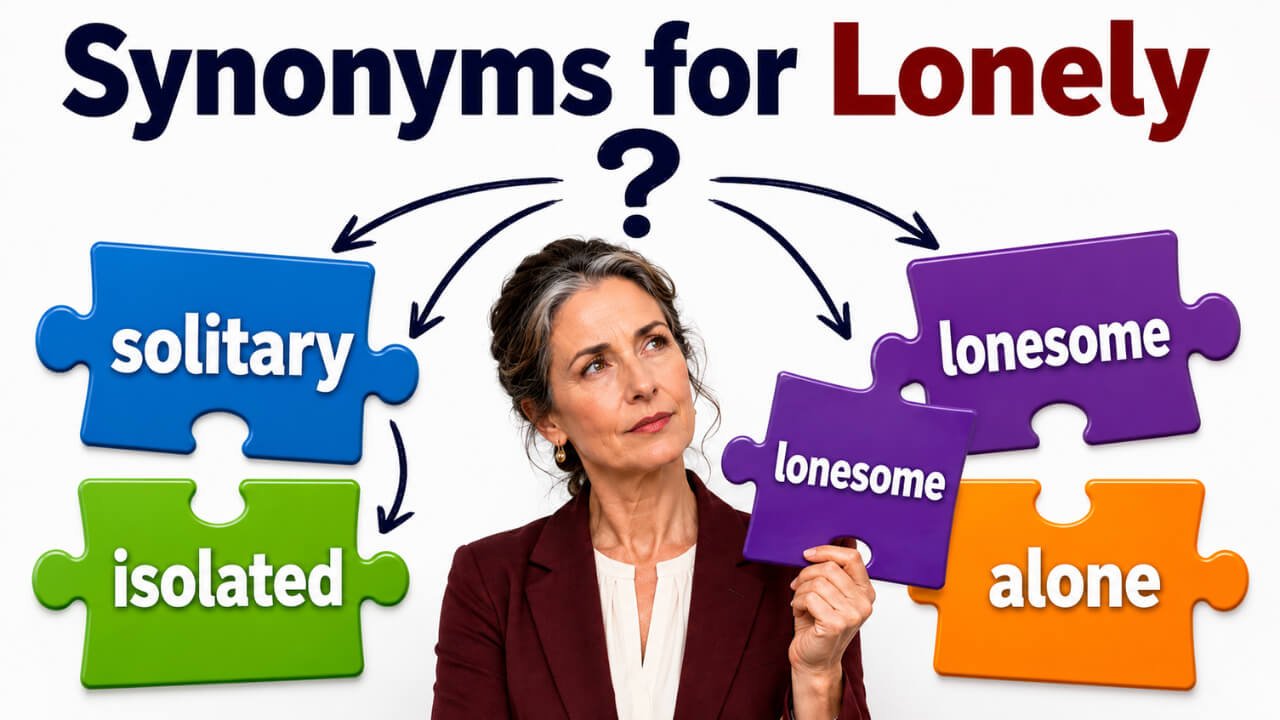
Quick Answer: Synonyms for lonely include alone, isolated, solitary, lonesome, friendless, abandoned, forsaken, alienated, secluded, and detached. Use alone when someone is without company, isolated when someone feels separated from others, solitary for neutral or formal writing, lonesome for emotional sadness, and alienated when someone feels socially or emotionally disconnected.
Pronunciation and Word Details
Word: Lonely
Pronunciation: ˈloʊnli
Part of Speech: Adjective
Meaning: Lonely means feeling sad, empty, or disconnected because of a lack of company, friendship, or emotional support.
US Pronunciation:
UK Pronunciation:
What Does “Lonely” Mean?
Lonely means feeling unhappy because you are alone, separated from others, or missing emotional connection. It is mainly used as an adjective.
The word can describe a person, place, mood, or situation. A person can feel lonely after moving to a new city. A road can look lonely when it is empty and quiet. A moment can feel lonely when someone has no one to share it with.
Example: She felt lonely after her closest friend moved away.
Meaning, Tone, and Context of “Lonely”
Lonely has an emotional, sad, and personal tone. It is common in everyday speech, personal writing, stories, poems, essays, and emotional descriptions.
The word is usually neutral in formality. It is not too casual, but it is also not highly academic. In formal or psychological writing, words like isolated, alienated, socially disconnected, or emotionally detached may sound more precise.
Lonely does not always mean physically alone. A person can feel lonely even in a crowd if they feel unseen, ignored, or emotionally distant from others.
When and How to Use “Lonely”
For Emotional Sadness: Use lonely when someone feels sad because they lack companionship or support.
Example: He felt lonely during the quiet winter evenings.
For Physical Separation: Use lonely when someone is by themselves and misses company.
Example: She felt lonely in the empty apartment.
For Social Disconnection: Use lonely when someone feels separated from a group or community.
Example: The new student felt lonely at school.
For Describing Places: Use lonely when a place feels empty, quiet, or far from people.
Example: A lonely road stretched across the valley.
For Personal Reflection: Use lonely when writing about inner feelings in a direct way.
Example: I felt lonely even though people were around me.
Best Synonyms for Lonely
Alone: Without other people nearby.
Example: She sat alone by the window.
Isolated: Separated from others physically, socially, or emotionally.
Example: He felt isolated after changing jobs.
Solitary: Alone, often in a calm, neutral, or formal sense.
Example: The writer enjoyed a solitary walk each morning.
Lonesome: Sad because of being alone.
Example: The old house felt lonesome at night.
Friendless: Having no friends or close support.
Example: The child felt friendless in the new town.
Abandoned: Left alone or forgotten by others.
Example: He felt abandoned after everyone stopped calling.
Forsaken: Completely left behind or deserted.
Example: She felt forsaken during her hardest days.
Alienated: Emotionally or socially separated from others.
Example: Many workers felt alienated in the large office.
Secluded: Quiet and away from other people.
Example: They stayed in a secluded cabin near the lake.
Detached: Emotionally distant or disconnected.
Example: He felt detached from the people around him.
50 Synonyms for Lonely with Short Meanings
- Alone: Without other people.
- Isolated: Separated from others.
- Solitary: Being by oneself.
- Lonesome: Sad from being alone.
- Friendless: Without friends.
- Abandoned: Left alone by others.
- Forsaken: Completely deserted.
- Deserted: Empty or left behind.
- Alienated: Socially disconnected.
- Detached: Emotionally distant.
- Secluded: Away from people.
- Remote: Far from others.
- Unaccompanied: Not with anyone.
- Companionless: Without companionship.
- Unbefriended: Without friendly support.
- Estranged: Emotionally separated.
- Withdrawn: Quiet and socially distant.
- Disconnected: Not emotionally connected.
- Apart: Separate from others.
- Separate: Not joined with others.
- Cut off: Removed from contact.
- Left out: Not included.
- Excluded: Kept away from a group.
- Rejected: Not accepted by others.
- Neglected: Not cared for properly.
- Unwanted: Not desired or welcomed.
- Ignored: Not noticed or listened to.
- Unloved: Not feeling loved.
- Bereft: Deeply lacking someone or something.
- Forlorn: Sad and abandoned.
- Desolate: Empty, sad, and bleak.
- Melancholy: Deeply sad or thoughtful.
- Downcast: Sad and discouraged.
- Dejected: Low in spirit.
- Blue: Sad in a casual sense.
- Sad: Unhappy or sorrowful.
- Hollow: Emotionally empty.
- Empty: Lacking warmth or feeling.
- Outcast: Rejected by a group.
- Marginalized: Pushed to the edge of a group.
- Unnoticed: Not seen or recognized.
- Homesick: Sad from missing home.
- Reclusive: Avoiding social contact.
- Private: Keeping away from others.
- Unsocial: Not mixing with people.
- Sequestered: Kept apart from others.
- Cloistered: Shut away from the outside world.
- Lone: Single or without others.
- Solo: Done or experienced alone.
- On one’s own: Without help or company.
Read Also:
Synonyms for Happiness

Synonyms for Lonely by Context
When Lonely Means Emotionally Sad
These synonyms work when loneliness is mainly about sadness, emptiness, or missing connection.
Lonesome: She felt lonesome after moving far from home.
Forlorn: He looked forlorn after everyone left.
Melancholy: The quiet evening gave her a melancholy feeling.
Dejected: He felt dejected when no one remembered his birthday.
When Lonely Means Physically Alone
These synonyms work when someone is not with other people.
Alone: She was alone in the room.
Unaccompanied: The child was unaccompanied at the station.
Solitary: He took a solitary walk through the park.
Solo: She made the trip solo.
When Lonely Means Socially Disconnected
These synonyms work when someone feels separated from a group, family, workplace, or community.
Isolated: He felt isolated after joining the new team.
Alienated: She felt alienated from her classmates.
Excluded: He felt excluded from the discussion.
Left out: The youngest child felt left out during the game.
When Lonely Means Abandoned or Forgotten
These synonyms are stronger and more emotional.
Abandoned: She felt abandoned when no one came to help.
Forsaken: He felt forsaken in his time of need.
Deserted: The village looked deserted after sunset.
Neglected: The elderly man felt neglected by his family.
When Lonely Describes a Place
These synonyms describe empty, quiet, or distant places.
Secluded: They found a secluded path near the river.
Remote: The cottage stood in a remote valley.
Desolate: The field looked desolate in winter.
Empty: The empty street felt lonely at night.
Another Word for Lonely
Another word for lonely is isolated, especially when someone feels separated from others emotionally or socially. However, the best single replacement depends on context. Use alone for a simple physical meaning, lonesome for sadness, solitary for a neutral tone, and alienated for social distance.
Original: She felt lonely in the new city.
Better Option: She felt isolated in the new city.
Original: He spent a lonely evening at home.
Better Option: He spent a lonesome evening at home.
Original: The writer chose a lonely life.
Better Option: The writer chose a solitary life.
Original: The worker felt lonely in the company.
Better Option: The worker felt alienated in the company.
When Not to Use “Lonely”
Do not use lonely when the meaning is only about being physically by yourself without sadness. In that case, alone, solo, or unaccompanied may be clearer.
Weak: She enjoys lonely walks every morning.
Better: She enjoys solitary walks every morning.
Avoid lonely in formal writing when you need a more precise word about social separation.
Weak: Many elderly people are lonely in modern cities.
Better: Many elderly people are socially isolated in modern cities.
Do not repeat lonely too often in emotional writing. Use stronger or more specific alternatives.
Weak: He felt lonely in a lonely room on a lonely night.
Better: He felt abandoned in an empty room on a silent night.
Words Commonly Confused With Lonely
Lonely vs Alone: Lonely means sad because of being without connection. Alone simply means not with others.
Lonely vs Solitary: Lonely is emotional and often sad. Solitary can be neutral, peaceful, or intentional.
Lonely vs Isolated: Lonely focuses on feeling. Isolated focuses on separation from people, places, or support.
Lonely vs Lonesome: Lonely is more common and general. Lonesome sounds warmer, more emotional, and slightly informal.
Lonely vs Alienated: Lonely can be personal sadness. Alienated means feeling pushed away from a group, society, or relationship.
Lonely vs Secluded: Lonely describes a feeling or empty atmosphere. Secluded describes a place that is private or far from people.
Which Synonym Should You Choose?
Choose alone when you mean someone is physically without other people.
Choose isolated when writing about social separation, emotional distance, health, community, or lack of support.
Choose solitary when the tone should be neutral, calm, formal, or not necessarily sad.
Choose lonesome when you want a softer emotional word for sadness caused by being alone.
Choose alienated when someone feels disconnected from a group, society, workplace, or family.
Choose abandoned when someone feels left behind or forgotten.
Choose secluded when describing a quiet place away from people.
Choose friendless when the main idea is having no friends or social support.
Choose desolate when describing a place or feeling that is empty, bleak, and sad.
Real Life Examples of “Lonely” in Sentences
Original: She felt lonely after moving to a new city.
Better Option: She felt isolated after moving to a new city.
Original: He spent a lonely night in the hotel.
Better Option: He spent a lonesome night in the hotel.
Original: The lonely road seemed endless.
Better Option: The deserted road seemed endless.
Original: I felt lonely at the party.
Better Option: I felt alienated at the party.
Original: The child looked lonely on the playground.
Better Option: The child looked left out on the playground.
Original: He lived a lonely life in the mountains.
Better Option: He lived a solitary life in the mountains.
Original: The old building looked lonely.
Better Option: The old building looked abandoned.
Original: She felt lonely without her family.
Better Option: She felt homesick without her family.
Original: He seemed lonely after retirement.
Better Option: He seemed socially isolated after retirement.
Original: The empty room felt lonely.
Better Option: The empty room felt desolate.
Synonym Groups and Usage Differences
Emotional Sadness Group
This group includes words that show sadness, emptiness, or emotional pain.
Useful Words: Lonesome, forlorn, melancholy, dejected, sad.
Example: He felt forlorn after his friends left.
Physical Aloneness Group
This group focuses on being without other people, but not always with sadness.
Useful Words: Alone, solitary, solo, unaccompanied, on one’s own.
Example: She traveled solo across the country.
Social Disconnection Group
This group describes feeling separated from a community, group, or relationship.
Useful Words: Isolated, alienated, excluded, left out, disconnected.
Example: The new employee felt alienated during meetings.
Abandonment Group
This group is stronger and suggests being left behind, forgotten, or unsupported.
Useful Words: Abandoned, forsaken, deserted, neglected, rejected.
Example: He felt abandoned when no one answered his calls.
Place Description Group
This group describes places that feel empty, quiet, distant, or bleak.
Useful Words: Secluded, remote, desolate, empty, deserted.
Example: The cabin stood in a remote forest.
Antonyms of Lonely
Connected: Feeling close to people or part of a group.
Included: Accepted as part of something.
Loved: Receiving care, affection, or emotional warmth.
Supported: Helped or encouraged by others.
Accompanied: Being with another person.
Sociable: Enjoying interaction with people.
Welcomed: Received with kindness and acceptance.
Popular: Liked or accepted by many people.
Surrounded: Having people around you.
Belonging: Feeling accepted in a place, group, or relationship.
Comparison: Lonely vs Related Words
Lonely vs Alone
Lonely means feeling sad because of a lack of connection. Alone only means being without others nearby.
Example With Lonely: She felt lonely after dinner.
Example With Alone: She was alone in the kitchen.
Lonely vs Isolated
Lonely focuses on the emotional feeling. Isolated focuses on being separated from people or support.
Example With Lonely: He felt lonely in the new school.
Example With Isolated: He felt isolated from his classmates.
Lonely vs Solitary
Lonely often sounds sad. Solitary can sound peaceful, chosen, or neutral.
Example With Lonely: She spent a lonely afternoon indoors.
Example With Solitary: She enjoyed a solitary afternoon reading.
Lonely vs Lonesome
Lonely is the more common general word. Lonesome feels warmer, softer, and more emotional.
Example With Lonely: He felt lonely in the empty house.
Example With Lonesome: He felt lonesome on the long ride home.
Lonely vs Alienated
Lonely can describe personal sadness. Alienated means feeling socially separated from others.
Example With Lonely: She felt lonely during the event.
Example With Alienated: She felt alienated from the group.
Common Phrases and Expressions With Lonely
Lonely Heart: A person who wants love or companionship.
Lonely Place: A place that feels empty or far from others.
Lonely Road: A quiet road with few or no people.
Lonely Night: A night that feels sad or empty.
Feel Lonely: To experience sadness from lack of connection.
Lonely Life: A life with little companionship or support.
Lonely Child: A child who seems without friends or comfort.
Lonely Crowd: A situation where someone feels alone around many people.
Lonely Silence: Silence that feels empty or sad.
Lonely Soul: A person who feels emotionally alone.
Common Mistakes to Avoid
Using Lonely for Every Type of Aloneness: Do not use lonely when someone enjoys being by themselves. Use solitary, alone, or solo instead.
Repeating Lonely Too Often: Repetition can make writing sound weak. Replace it with isolated, lonesome, abandoned, or alienated when the meaning fits.
Confusing Lonely and Alone: Alone is a state. Lonely is a feeling.
Choosing Too Strong a Synonym: Words like forsaken, desolate, and abandoned are emotional and strong. Use them only when the sentence needs deeper sadness.
Using Formal Words in Casual Sentences: Alienated and socially isolated may sound too formal in simple conversation. Use lonely, left out, or alone instead.
Ignoring Context: The best synonym depends on whether you mean sadness, separation, rejection, distance, or an empty place.
Conclusion
Synonyms for lonely help you describe sadness, separation, emotional distance, and empty places with more accuracy. Use alone for physical separation, isolated for social or emotional distance, solitary for a neutral tone, lonesome for gentle sadness, and alienated for feeling disconnected from others. Stronger words like abandoned, forsaken, and desolate work best when the feeling is deeper or more painful.
FAQs About Synonyms for Lonely
What are the best synonyms for lonely?
The best synonyms for lonely are alone, isolated, solitary, lonesome, friendless, abandoned, forsaken, alienated, and secluded.
What is another word for lonely in emotional writing?
A good emotional synonym for lonely is lonesome. It sounds warm, sad, and natural in personal writing.
Is lonely the same as alone?
No. Alone means without other people. Lonely means feeling sad or disconnected because of being alone or unsupported.
What is a formal synonym for lonely?
A formal synonym for lonely is isolated. In serious writing, socially isolated or alienated may also work well.
What is a stronger word than lonely?
Stronger words than lonely include abandoned, forsaken, desolate, and alienated. These words show deeper sadness or rejection.
Can lonely describe a place?
Yes. Lonely can describe a place that feels empty, quiet, distant, or abandoned.
Example: A lonely road crossed the empty field.
What is the opposite of lonely?
The opposite of lonely can be connected, included, loved, supported, welcomed, or accompanied, depending on the sentence
