
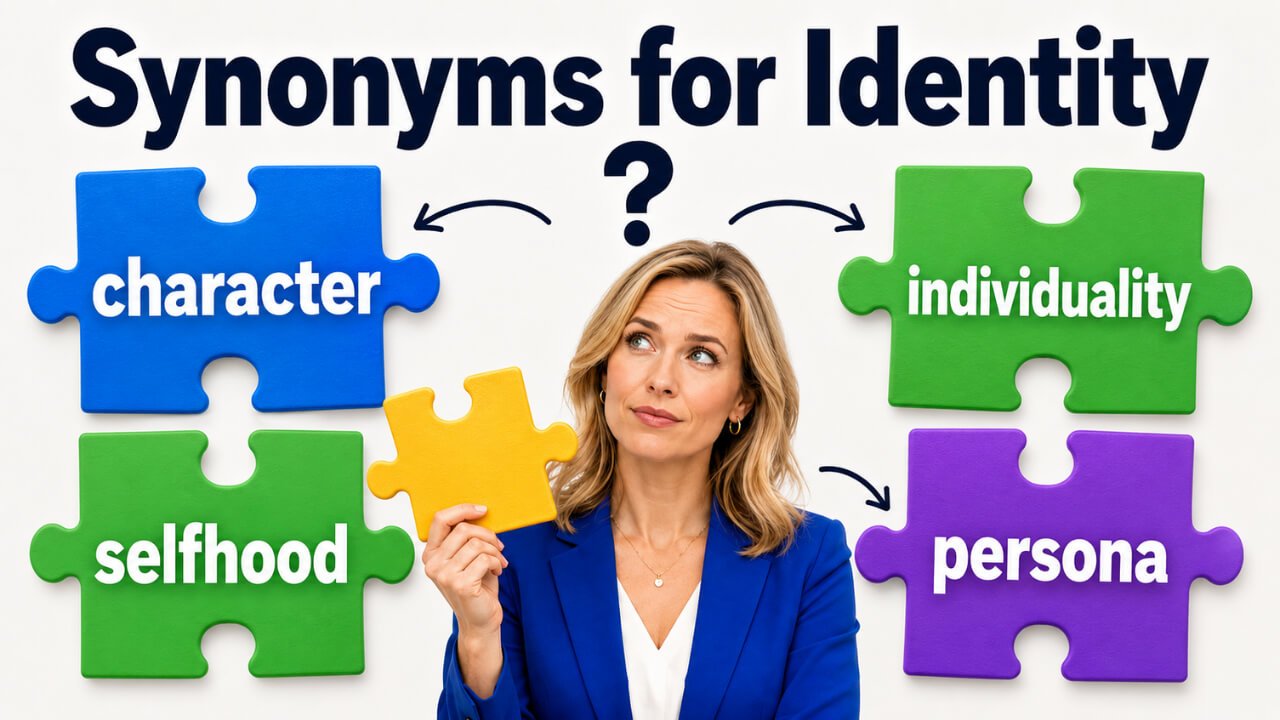
Quick Answer: Synonyms for identity include selfhood, individuality, character, personality, persona, nature, name, recognition, profile, and uniqueness. Use selfhood when talking about a person’s inner sense of self. Use individuality when focusing on what makes someone different. Use character for moral or personal qualities. Use persona for a public image. Use name, identification, or recognition when referring to official details or proof.
Pronunciation and Word Details
Word: Identity
Pronunciation: /aɪˈdɛn.tə.ti/
Part of Speech: Noun
Meaning: Identity means who or what a person, group, or thing is, including the qualities, facts, name, or features that make it recognizable.
US Pronunciation:
UK Pronunciation:
What Does “Identity” Mean?
Identity means the qualities, facts, name, or features that make someone or something recognizable. It is a noun used for personal, social, cultural, official, and descriptive meanings.
Identity can describe who a person is, how a group defines itself, what makes a thing unique, or how someone is officially recognized. In a sentence, identity may refer to a person’s inner self, public image, legal information, cultural background, role, values, or distinctive traits.
Example: Her identity is shaped by her family, language, values, and personal experiences.
Meaning, Tone, and Context of “Identity”
Identity is usually neutral, but its tone changes by context. In personal writing, it can feel emotional or reflective because it connects to selfhood, belonging, and experience. In academic writing, identity often appears in discussions about culture, society, language, psychology, and community. In official writing, identity can refer to a name, document, record, or verification.
Formal context: Identity can mean official recognition or proof of who someone is.
Personal context: Identity can mean a person’s sense of self, values, and background.
Cultural context: Identity can describe shared traditions, language, beliefs, and history.
Creative context: Identity can mean a unique style, voice, or recognizable quality.
When and How to Use “Identity”
For Personal Selfhood: Use identity when describing who someone is as a person.
Example: He spent years trying to understand his identity and purpose.
For Cultural Belonging: Use identity when discussing community, heritage, tradition, or shared background.
Example: Language is an important part of cultural identity.
For Official Recognition: Use identity when referring to legal details, documents, records, or proof.
Example: The office asked for proof of identity before processing the form.
For Unique Qualities: Use identity when describing what makes something different or recognizable.
Example: The city has a strong identity because of its art, food, and architecture.
For Public Image: Use identity when talking about how someone or something is seen by others.
Example: The speaker created a calm and thoughtful public identity.
Best Synonyms for Identity
Selfhood: A person’s sense of being a distinct individual.
Example: The novel explores selfhood through memory and choice.
Individuality: The qualities that make a person or thing different from others.
Example: Her individuality appears in her writing style.
Character: The moral, personal, or distinctive qualities of someone or something.
Example: His character is shown through his honest actions.
Personality: The traits, behavior, and qualities that make someone recognizable.
Example: The teacher’s warm personality made students feel comfortable.
Persona: The image or role someone presents to others.
Example: His public persona is confident and polished.
Nature: The basic qualities or true character of a person or thing.
Example: The nature of the project changed after the first review.
Name: A word or title used to identify someone or something.
Example: She used a different name to protect her identity.
Recognition: The act of knowing or identifying someone or something.
Example: The symbol helped with quick recognition.
Profile: A public description or image of a person, group, or thing.
Example: The candidate built a strong professional profile.
Uniqueness: The quality of being different from everything else.
Example: The uniqueness of the design gave the product its identity.
50 Synonyms for Identity with Short Meanings
- Selfhood: A person’s sense of being a separate self.
- Individuality: Qualities that make someone distinct.
- Character: Personal or moral qualities.
- Personality: Traits and behavior that define someone.
- Persona: Public image or presented role.
- Nature: Basic qualities of a person or thing.
- Essence: The most important inner quality.
- Self: The person as a distinct being.
- Personhood: The state of being a person.
- Uniqueness: The quality of being one of a kind.
- Distinctiveness: A noticeable difference from others.
- Name: A word used for identification.
- Identification: Proof or act of recognizing someone.
- Recognition: Knowing who or what something is.
- Profile: Public description or image.
- Image: The way someone or something is seen.
- Reputation: Public opinion about someone or something.
- Role: A position or function someone has.
- Status: Social, legal, or official position.
- Standing: Position or reputation in a group.
- Background: Personal, social, or cultural history.
- Heritage: Traditions or qualities passed through history.
- Culture: Shared beliefs, customs, and ways of life.
- Belonging: Feeling connected to a group or place.
- Affiliation: Connection with a group or organization.
- Origin: Where someone or something comes from.
- Roots: Deep personal, family, or cultural connections.
- Makeup: The parts or qualities that form something.
- Composition: The elements that make something complete.
- Definition: A clear explanation of what something is.
- Description: Details that explain or identify something.
- Designation: An official name, title, or label.
- Label: A word used to classify or identify.
- Classification: Grouping by type or shared qualities.
- Category: A group with shared features.
- Type: A kind or class of person or thing.
- Kind: A particular sort or nature.
- Trait: A specific personal quality.
- Feature: A noticeable part or quality.
- Attribute: A quality or characteristic.
- Characteristic: A typical quality or feature.
- Quality: A feature that describes someone or something.
- Signature: A distinctive style or mark.
- Voice: A unique style of expression.
- Style: A recognizable way of doing or expressing something.
- Presence: Noticeable personal effect or impression.
- Authenticity: Being true to one’s real self.
- Ego: Sense of personal self or importance.
- Personal self: Inner sense of who someone is.
- Public image: How someone is seen by others.
Read Also:
Synonyms for Advocate

Synonyms for Identity by Context
When Identity Means Personal Self
Selfhood: He struggled to define his selfhood after moving to a new country.
Individuality: Her individuality made her stand out in the group.
Personal self: The poem describes the speaker’s personal self with honesty.
Personhood: The essay discusses dignity, personhood, and human value.
When Identity Means Official Recognition
Identification: The officer asked for identification at the entrance.
Name: The record listed the wrong name.
Designation: The file gave each visitor a clear designation.
Recognition: The mark helped with quick recognition.
When Identity Means Public Image
Persona: The actor’s calm persona made him memorable.
Profile: The writer built a respected profile in her field.
Image: The leader’s image changed after the speech.
Reputation: His reputation became part of his professional identity.
When Identity Means Unique Quality
Uniqueness: The uniqueness of the design made it easy to remember.
Distinctiveness: The town’s distinctiveness comes from its old streets and local food.
Signature: Her signature style is simple, direct, and elegant.
Character: The old house has character because of its original details.
When Identity Means Cultural Belonging
Heritage: Food can be a strong part of heritage.
Culture: Art often reflects the culture of a community.
Roots: His roots influenced his music and writing.
Belonging: The festival gave many people a sense of belonging.
Another Word for Identity
The best single word for identity is selfhood when the meaning is personal. However, the best alternative depends on context. Use individuality for uniqueness, identification for official proof, persona for public image, and character for personal qualities.
Original: She is still trying to understand her identity.
Better Option: She is still trying to understand her selfhood.
Original: The school has a strong identity.
Better Option: The school has a strong character.
Original: The document confirms his identity.
Better Option: The document confirms his identification.
Original: Her identity as an artist is easy to recognize.
Better Option: Her artistic persona is easy to recognize.
When Not to Use “Identity”
Do not use identity when a more exact word would be clearer. Identity can sound broad if you mean only a name, role, style, background, or official proof. It can also become repetitive if used many times in one paragraph.
Weak: The identity of the shop is friendly, and its identity is modern.
Better: The shop has a friendly character and a modern style.
Weak: Please show your identity at the desk.
Better: Please show your identification at the desk.
Weak: Her identity in the team is manager.
Better: Her role in the team is manager.
Weak: The painting has a colorful identity.
Better: The painting has a colorful style.
Words Commonly Confused With Identity
Identity vs Selfhood: Identity is broader and can include name, culture, role, records, and public image. Selfhood mainly means the inner sense of being a person.
Identity vs Personality: Identity is who someone is overall. Personality is the set of traits, habits, and behaviors people notice.
Identity vs Persona: Identity can be real, personal, official, or social. Persona means the image or role someone presents to others.
Identity vs Identification: Identity means who or what someone is. Identification means proof, recognition, or the process of identifying.
Identity vs Character: Identity is a broader idea of who someone is. Character focuses more on qualities, values, and moral behavior.
Identity vs Image: Identity can be internal and external. Image is mostly how someone or something appears to others.
Identity vs Role: Identity can include many parts of a person or group. Role means a specific function or position.
Which Synonym Should You Choose?
Choose selfhood when writing about a person’s inner sense of who they are.
Choose individuality when describing what makes someone different from others.
Choose character when focusing on values, qualities, or distinctive nature.
Choose personality when talking about behavior, attitude, and visible traits.
Choose persona when describing a public image or performed role.
Choose identification when discussing official proof, records, documents, or verification.
Choose profile when writing about public description, career image, or professional presence.
Choose heritage when writing about cultural background, family history, or tradition.
Choose uniqueness when emphasizing difference or originality.
Choose reputation when describing how others judge or remember someone.
Real Life Examples of “Identity” in Sentences
Original: Her identity changed as she learned more about her family history.
Better Option: Her selfhood changed as she learned more about her family history.
Original: The company has a clear identity.
Better Option: The company has a clear character.
Original: He showed his identity at the front desk.
Better Option: He showed his identification at the front desk.
Original: The artist’s identity is visible in every painting.
Better Option: The artist’s signature style is visible in every painting.
Original: Their identity is connected to language and tradition.
Better Option: Their heritage is connected to language and tradition.
Original: She built a strong identity as a calm leader.
Better Option: She built a strong public image as a calm leader.
Original: The village has a peaceful identity.
Better Option: The village has a peaceful character.
Original: His identity is based on honesty and discipline.
Better Option: His character is based on honesty and discipline.
Original: The group protected its identity through shared customs.
Better Option: The group protected its culture through shared customs.
Original: The document was used to confirm her identity.
Better Option: The document was used to confirm her identification.
Synonym Groups and Usage Differences
Personal Self Group
Words like selfhood, self, personhood, and personal self focus on inner life and personal existence. Use these when the sentence is about who someone feels they are.
Example: Writing helped her understand her selfhood.
Uniqueness Group
Words like individuality, uniqueness, distinctiveness, and signature focus on what makes someone or something different. Use these when comparing one person, place, or thing with others.
Example: The building’s distinctiveness comes from its unusual shape.
Public Image Group
Words like persona, image, profile, reputation, and presence focus on how someone or something appears to others. Use these in public, professional, or social contexts.
Example: His profile grew after years of consistent work.
Official Recognition Group
Words like identification, name, designation, label, and recognition focus on proof, naming, or classification. Use these when talking about forms, records, systems, or verification.
Example: The card served as identification.
Cultural Belonging Group
Words like heritage, culture, roots, background, and belonging focus on shared history, community, or tradition. Use these when discussing social or cultural connection.
Example: Her roots shaped her writing voice.
Antonyms of Identity
Anonymity: A state of being unknown or unnamed.
Difference: A lack of sameness or shared identity.
Confusion: Lack of clear recognition or understanding.
Uncertainty: Lack of certainty about who or what someone is.
Impersonality: Lack of personal identity or individual character.
Namelessness: A state of having no known name.
Obscurity: A state of being unknown or not easily recognized.
Similarity: Likeness that reduces distinct identity.
Mismatch: A difference between claimed identity and actual details.
Disguise: A changed appearance that hides real identity.
Comparison: Identity vs Related Words
Identity vs Selfhood
Identity is a broad word that can include personal, social, cultural, legal, and public meanings. Selfhood focuses mainly on a person’s inner sense of being a separate individual.
Example With Identity: Her identity includes her language, values, and experiences.
Example With Selfhood: Her selfhood grew stronger as she became more independent.
Identity vs Individuality
Identity can describe who someone is overall. Individuality emphasizes the qualities that make someone different from others.
Example With Identity: His identity is connected to his family history.
Example With Individuality: His individuality appears in his bold design choices.
Identity vs Personality
Identity is the larger idea of who someone is. Personality refers to traits, habits, behavior, and emotional style.
Example With Identity: Her identity changed after moving to a new city.
Example With Personality: Her cheerful personality made the meeting easier.
Identity vs Persona
Identity may be real, private, official, or social. Persona is the image someone presents in public or in a specific role.
Example With Identity: He wanted to protect his identity.
Example With Persona: His confident persona helped him on stage.
Identity vs Identification
Identity means who or what someone is. Identification means proof of identity or the act of recognizing someone.
Example With Identity: The story explores the child’s identity.
Example With Identification: The guard checked her identification.
Common Phrases and Expressions With Identity
Personal Identity: A person’s sense of who they are.
Cultural Identity: A sense of belonging to a culture or community.
National Identity: A shared sense of belonging to a nation.
Social Identity: How someone is connected to a group or society.
Public Identity: The way a person or group is known by others.
True Identity: The real name or nature of someone or something.
Hidden Identity: A concealed name, role, or true self.
Mistaken Identity: A situation where someone is wrongly recognized as another person.
Identity Crisis: A period of confusion about one’s sense of self.
Proof of Identity: A document or detail used to confirm who someone is.
Common Mistakes to Avoid
One common mistake is using identity when identification is more accurate. Identity means who someone is, while identification often means proof or verification.
Another mistake is using identity too often in the same paragraph. Replace it with selfhood, character, profile, culture, or individuality when the meaning is specific.
Writers also confuse identity with personality. Personality is only one part of identity. A person’s identity may include background, values, role, culture, name, and personal history.
Avoid vague phrases like strong identity without explaining what makes that identity strong. Say strong cultural identity, clear public image, unique style, or defined character when you need a sharper meaning.
Conclusion
Synonyms for identity help you write more clearly about who someone is, how something is recognized, and what makes a person, group, or thing unique. Use selfhood for inner self, individuality for difference, character for qualities, persona for public image, identification for official proof, and heritage for cultural background. The best synonym depends on whether you mean personal meaning, public recognition, official details, uniqueness, or belonging.
FAQs About Synonyms for Identity
What is the best synonym for identity?
The best synonym for identity is selfhood when talking about a person’s inner sense of self. For official use, identification is better.
What is another word for identity in writing?
Another word for identity in writing can be individuality, character, persona, profile, or nature, depending on the sentence.
Is personality a synonym for identity?
Personality can be a synonym in some contexts, but it is not always the same. Personality means traits and behavior, while identity is broader.
What is a formal synonym for identity?
A formal synonym for identity is identification, especially when discussing proof, records, documents, or verification.
What is a synonym for cultural identity?
Good synonyms or close alternatives for cultural identity include heritage, culture, roots, background, and belonging.
What is a synonym for public identity?
Good synonyms for public identity include persona, profile, image, reputation, and public image.
What is the opposite of identity?
Opposites of identity include anonymity, namelessness, obscurity, confusion, and uncertainty, depending on the context
